
Newsletter Late Summer 2010
(In this issue:
Confessions of a Needlepoint Addict,
Helpful Hints, and Needlepointers
Glossary)
Hello again needlepoint friend. It's
summer in earnest in Florida, and although many have heard we're just covered up
with the oil spill, actually it hasn't been that bad here in the "Panhandle."
We have had a few episodes of oil and tar on our dazzlingly white beaches, but
not nearly as much as we expected. This is survivable, we're coming to
believe.
I was just thinking though, not
too long ago about a subject sometimes discussed in our local stitchery guild
meetings. We talk about our "designated retriever." This is the
person who has the job of going to our homes and retrieving our unfinished projects,
canvases, and other needle work items in case something happens to us.
They then finish the items and give them back to the family, or offer to sell it
for them and give the money to the family. So,
they're the designated retriever. Not a bad idea, especially if others in
your home don't have the same appreciation for your hobby that you have.
On that note, I remember soon
after I (an avid stitcher and teacher) started dating my husband, Roger, he came
to dinner. While he was there he saw a portion of my stash of needlepoint
canvases and kits.
“What is that,” he asked“
“My stash.”
“Why isn’t it in the other
room.”
“Because, it is my stash.”
"Do
you use it to teach classes?”
“No, it is my stash.”
"Do you sell it?”
“Of course not, it is my
stash.”
“What in the world do you do
with a stash?”
“Well, sometimes I add to it”
We married anyway!
No doubt many of us have had
similar experiences. We are, after all, a unique group, to say the least.
OK, enough personal stuff;
let's get to this summer's educational material.
First, I wanted to
be sure you see the new additions from
Collection d'Art and Royal Paris. Now for your summer school...
Helpful
Hints:
Help for seeing black canvas is
to put a white piece of fabric on your lap which also helps the holes to appear
larger. Stitching on white can also sometimes present a problem, so in this case
something black will have the same effect.
Needles are manufactured by
stamping a hole for the eye. Therefore one side is definitely easier to thread
than the other. If you are having trouble threading a needle, try turning it
around and see if the thread goes through the other side of the eye more easily.
Does the thread you are using
not quite cover the canvas, but another strand would be too thick? Every few
stitches, place an additional stitch over one that is already completed. This
will not be obvious and will increase the coverage.
"When in doubt, leave it out.”
When you are stitching and wondering whether you will need to compensate a
particular area, leave it blank. It is much easier to add a stitch or two later
than it is to have to take something out.
Glossary for Needlepointers:
This abbreviated list is
by no means new to our newsletters, but it's always good to go over the basics.
Besides, some of the definitions here have been enhanced to add to your
knowledge base.
Bargello:
A Florentine pattern based on chairs now located in the Bargello Palace in
Florence, Italy
Basketweave: One of the basic
stitches of needlepoint. It is sometimes referred to as the diagonal tent
stitch. It belongs to the family of stitches including the continental, and half
cross.
Blackwork: Needlework
traditionally worked in dark thread on a light background. Black and white
stitching is mentioned in Chaucer’s Canterbury Tales, written between 1388 and
1400 and for centuries it has been found in peasant embroideries of eastern
European countries. Of great antiquity, blackwork is believed to have originated
in the Eastern Mediterranean and traveled with the Moors to Spain. Catherine of
Aragon, the Spanish wife of Henry VIII popularized it in England during the 16th
century.
Cotton: A natural fiber from
the cotton plant. Several varieties are grown, Sea Island, Pima, and Egyptian
being the finest. When wet, the fiber swells.
Floss: Used to refer to
6-strand cotton.
Mercerized: This process,
devised by John Mercer, treats cotton thread with caustic soda to give strength,
sheen and an increased affinity for dyes. This is used mostly on cotton, but
sometimes on linen.
Metallic threads: Threads which
have the appearance of metal threads but are made of synthetic materials. These
threads are used to embellish needlepoint and are easy to work with.
Needlepoint: An American term
for canvas embroidery.
Perle Cotton: A tightly
twisted, non-divisible cotton thread. Labeled as cotton perle, it literally
translates as beaded cotton and comes from the French verb perler which means to
bead or form into beads. Probably, so named because the twist looks like beads.
Persian Wool: A long-fibered
wool yarn with a sheen, can be separated into 3 strands. It was called Persian
by the Paternayan Brothers, as it was used to repair Persian carpets. Thread
consisting of three strands of 2-ply long-staple wool ,that may be separated
into 1, 2, or 3 threads for use on various sizes of canvas.
Petitpoint: Very small stitches
on canvas. Usually 18-22 stitches per inch. The name is derived from a French
term.
Tapestry Wool: Lightly twisted
wool used for canvas work. Used without separating the strands.
Trame’: A system of laying yarn
on top of the canvas grid and stitching over it. This is sometimes used as a
guide for color stitching and offers a padding technique.
New Stuff:
Collection d'Art has added
several new items to its collection. You can see them by
clicking here.
There have also been some new
Royal Paris and
SEG de Paris
items added recently. These last two companies are our most popular
brands. Below are some samples:
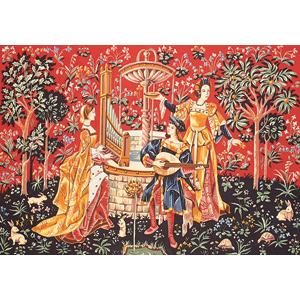
Lady and the White Horse from Collection d'Art
Cote Jardin from Royal Paris
Elle from Margot de Paris
You can
click here to see all
the newest entries.
OK, there you have it. Have a wonderful summer. And again remember…it is never too early to start on
holiday projects.
Janice Lindsey and the crew at
NeedlepointUS.com
Newsletter Spring/Summer 2010
(In this issue:
Back to Basics,
Getting Started, and When You're Ready
to End It All)
Dear fellow stitchers:
Welcome to our Spring/Summer 2010 (can you
believe it??!!) newsletter. Summertime should be a time for relaxing with
favorite pastimes. Spending cherished time with our needlepoint projects is the
perfect way to keep our needlepoint passion alive.
These times create memories that are with us
forever. It is amazing how needlepoint transcends time and place. I have noticed
that looking back at something I stitched takes me back to the events that
happened in my life at the time, when I was working on the project. This is such
a comforting feeling. I am sure this is true for you also.
You know you are a stitcher when your children
have learned that a peanut butter and jelly sandwich is a perfectly acceptable
three course meal (bread, protein, dessert) because you are usually too busy
stitching “just one more row” to remember to put the roast in the oven. That’s a
joke of course!
OK, now for the “meat” of the subject matter…
Back to the Basics
We still have a large number of questions about
basic things of needlepoint, so I’m going to go over some of it again in this
part of the newsletter.
Count or mesh size: This is expressed in
units per inch. 18 count or 18-mesh means there are 18 warp and 18 weft threads
per linear inch thus 18 stitches to the inch. #14 means 14 stitches to the inch
etc.
Penelope (used by most of the French
manufacturers on our site -
Margot de Paris,
Royal Paris,
SEG de Paris) is
a double mesh canvas made in Europe. This canvas gives you the opportunity to
vary your stitches; i.e. petit point and regular needlepoint. Penelope is
usually a 10/20 count. In other words, if you use the large holes with a regular
needlepoint stitch you will have 10 stitches to the inch; 20 stitches to the
inch if you do petit point. You can do a combination of each.
When preparing your canvas for stitching using a
frame, always put the canvas on the stitching frame so that the warp is up and
down (lengthwise) to you and the weft runs from the left to right or sideways.
The warp is stronger than the weft.
We do recommend using a
stitching frame for
your work. It keeps your canvas in shape for you to stitch and makes stitching
easier. We do not recommend an embroidery hoop because it can leave creases on
the needlepoint canvas. We will be happy to assist you in choosing the proper
stitching frame for your project. We also have lap frames and floor frames with
which you can use different size scroll frames. These are great as it holds the
frame for you and allows for effortless rotation for your stitching.
Getting started:
Always stitch with clean hands.
Replace tarnished needles as you stitch.
Uniform tension is a sign of a good stitcher. This develops over time. You don’t
want to pull too tightly or you may distort the canvas or not get good coverage
with the thread. But you don’t want to pull too loosely either as this will
produce uneven results. When resuming a project, compare your stitch with those
you did earlier. Your stitching may look different if you were relaxed before and
are stressed now. Using stretcher bars or scroll frame will help your tension
remain even.
There are several ways to start your threads. One of the easiest is to use a
waste knot. Knot your thread and bring your needle down through the canvas from
the front about ľ” or so from the direction that you will be stitching. Your
stitches will cover this “tail” and secure it. Afterward clip the knot off very
carefully. You can also start by leaving a tail on the back of the canvas and as
you stitch you will stitch over the tail covering it completely.
When You’re Ready to End It All!
Ending threads invisibly and securely is a skill that is essential to the
accomplished needlepointer. When it comes time to end a thread, there are
several options. The easiest is not to choose; just leave the thread dangling on
the back or pull it to the front at a margin to be dealt with later. This just
postpones the dilemma, but sometimes it buys you time to stitch another area
that allows securing the first thread in a solid area of the back. Be sure you
have at least three inches of thread to make the later securing easier.
There are a few general guidelines for ending a thread. Try to end in an area of
the same color so there’s less chance for a shadow to show on the front. A black
thread buried in a white area will usually show through the front. End the
thread so the pull of the stitch is continued, so that the last stitch keeps the
same directional pull as all of the stitches before it.
Securing threads in basketweave can be done two ways. You can tunnel the thread
through about an inch of stitching on the reverse. Always bury the thread
horizontally or vertically. If you bury it diagonally, as you have been
stitching, you’ll probably pull the stitches tight. This will cause the ending
to be noticeable from the front, because you’re going under stitches in the
order they were stitched. If you bury on the horizontal or the vertical, the
stressed stitches aren’t next to each other as they were stitched, so the
distortion is spread over a larger area.
Another way to end a basketweave area is a drop stitch. When you come to the end
of the thread, drop down about an inch vertically and bring it to the front of
the canvas. Clip it off, leaving a one inch tail at the top of the canvas. Begin
a new thread with an inline waste knot and continue stitching. When the inch of
thread on the back of the canvas is covered with basketweave stitches, from the
front, pull the tail upward and cut it of flush with the canvas. The end will
pop back into the stitching, and you won’t have stressed any of your basketweave
stitches by tunneling under them.
Whatever method of securing the thread end you select, there’s one essential
rule: Cut it short. When you’ve anchored the thread, cut it close to the
stitching – no half-inch tails hanging where they can shadow through the canvas
and be seen from the front. Trust your fixing of the thread end and cut that
tail right next to the canvas. The quality of your finished piece will be better
for your attention to the thread ends.
Never leave knots on the back of your canvas. They can produce bumps that will
show on the front.
When doing the” frog stitch” (rip it, rip it…a little stitching humor) do not
reuse the thread you have unstitched. It will be worn and would look different if
re-stitched.
Now that your brain has been permanently rattled with all this detail, take a
breath and do some looking around for a new, or future, project on our website.
Don’t forget the new Wish List feature where you can log in and save items to a
wish list for future reference, or for emailing to friends and family as a hint.
We have a couple of new lines of products from England; Primavera and Animal
Fayre. These kits are detailed and easy to stitch. Some even come with beads for
embellishing your work. Many new items are available and I encourage you to find
a piece that will bring you stitching pleasure this summer.
You will find we have some wonderful mini kits including holiday ones that are
easy to take with you this summer.
We are always available to assist you in any project.
Don’t forget to check out the
Sale items since we are adding items to this
category on a regular basis, and the new
Animal Fayre items.
This is probably the most exciting new addition of recent times. Some of
them come kitted with beads and semi-precious stones to give it a knock-out
look.
I also recommend
you take a look at the new
Primavera line...some
really beautiful stuff in there.
If you're going on
vacation this year, take along one of our convenient
miniatures for those
relaxing stitching moments on vacation.
Have a wonderful summer. And again remember…it is never too early to start on
holiday projects.
Janice Lindsey and the crew at
NeedlepointUS.com
Newsletter Winter 2009-10
(In this issue:
A "Bio" of Yarns and Threads,
A Brief Study of Color), New additions,
and New features)
Dear Stitchers:
We will all probably remember the “blizzards” of 2009-2010 the rest of our
lives. Even though the weather outside was “frightful," we could all
stitch by the “delightful” fire. Don't know about you, but It gave me a good
excuse to stay inside with a hot cup of tea and stitch my many projects that are
yet to be finished. In Florida we did have the coldest winter I can remember in
many years and I know it does not compare to the winter the majority of you had.
But then when it is so hot here in the summer it will be good to remember the
cold weather.
In our last issue, we gave some basic
information on the yarns we offer in our kits on
NeedlepointUS.com. In
this issue I would like to expand on that and give you a short "bio" of these
threads; wool, perle cotton and cotton floss:
Yarns
Wool:
Examples of wool used in needlework dates back
at least to the Middle Ages and probably earlier. There is no record of
the earliest embroideries, but surviving to this day is the
Bayeux Tapestry (on display at the museum in Bayeux, Normandy, France - some
details from it are available on our site
here) which dates back to the 11th century. It is an example of crewel
embroidery using two kinds of wool on a linen background. In the nineteenth
century Berlin Wool Work became popular, using colored charts to produce designs
with wool manufactured in Germany and dyed in Berlin (thus the name). Today wool
is found in many needlepoint kits and gives an “old world” look to the design.
Wool thread comes in many forms: tapestry,
crewel and Persian, and in combination with other fibers. Tapestry wool has a
light twist and is non-divisible. Crewel and Persian wools have looser twists
and should be separated and recombined before use. Some wools have a hairy
finish; others are smooth by comparison. Composed of cells, the outside of
wool thread is scaly providing small areas for light reflection. The result is
low luster with a muted or darker appearance of the thread’s color. Use
wool when you want a subtle, soft, even warm feel to the area being stitched.
The surface texture of the wool adds depth to stitches by emphasizing the
shadows that add texture to the stitches.
Cotton:
Cotton sees use almost as early as
civilization itself. The cultivation and production of it began in the
Indus Valley Civilization, several thousand years BC. . From there
it spread to the rest of the world. Cotton threads became popular in
the late 1950’s to early 1960‘s and remain popular today. Cotton is a natural
fiber which is processed in several steps: the cotton bolls are cleaned,
removing all dirt; the longer fibers are carded (separated and pulled parallel
to each other); the carded fibers are collected as slivers or ropes which are
then combed, removing shorter fibers. After combing they are pulled
through a series of rollers, reducing their thickness (rovings); the rovings are
spun into thread. Some threads go through an additional process of being treated
with caustic soda, causing the naturally flat twisted thread to swell and become
rounded and smoother, giving it more sheen.
Many varieties of cotton thread are available
today . Floss, or stranded cotton, is a Mercerized thread with high luster and
should be separated and recombined before use. The floss will lie flat to the
canvas and give your design a look of satin. For many of our canvases it is best
to use 9 strands instead of the normal 6. This will cover the canvas better and
give additional dimension to the design. Perle cotton is a lightly twisted
cotton with wonderful texture and sheen. It is available in several weights and
is non-divisible. Because of its texture and sheen it provides a good contrast
for your stitching, and it will add dimension to your design giving a wonderful
sheen. Perle cotton is wonderful and soft to work with. Using it will give a
design, especially of flowers, a beautiful look.
A
Brief study of Color:
Since it is so important to our finished
needlework, I thought you might find the following information interesting.
Value of color depends on the amount of
darkness or light in the color.
Shade is the result of adding black to a color.
Tint is the result of adding white to a color.
Tone is the result of adding gray or complementary color.
Intensity is the degree of brilliance or grayness of a color.
Primary Colors are yellow, red, and blue. All other colors are combinations of
the primary colors. Use these colors for boldest effects.
Secondary Colors are the colors halfway between the primary colors: secondary
colors are orange, violet, and green.
Tertiary Colors are the colors between the primary and secondary dolor groups.
This includes yellow-orange, red-orange, red-violet, blue-violet, and
yellow-green.
Complementary Colors are colors directly opposite each other on the color wheel.
A color when used in a small amount to its complementary color, will be
intensified. Use this when you want a small item to stand out. When
complementary colors are used in equal amounts, they produce a grayed effect.
Analogous Colors are adjacent colors on the color wheel. Any group of colors
which lie next to each other on the color wheel will blend softly and be safe to
use together. Warm colors are those belonging to the red and yellow group. Cool
colors are those belonging to the blue and green group. A touch of white will
give a clean, sparkling effect to a design. Fine black lines around colors will
heighten and define them.
Color Fusion occurs when two colors of equal intensity are used together in
small amounts, such as using one strand of each color and working them together.
The eye tends to fuse them into one color. The blue and green of a peacock’s
feather is a good example.
New additions:
We think you will like our newest additions
from the Primavera
Company out of the UK, world renowned for its collection of floral and
Shaker style designs, charming regional designs, and a collection of animal
designs. These items are being added on a regular basis, so be sure to
check back.
There have also been some really nice
additions to the SEG
de Paris collection. Please
click here
to see some of them.
New Wish List
Feature:
We have added a new feature to the website as
well. Now you can log in and begin adding items to your very own wish
list. It's very simple to log in and get started, and it's the best way to
keep track of what interests you on the site. You'll see a link in the
upper left hand margin of just about every page on the site, or you can
click here to get started now.
Hope you enjoy the rest of your winter.
Happy stitching!
Janice Lindsey and the crew at
NeedlepointUS.com
Newsletter Summer 2009
(In this issue:
Helpful Hints, History of "Blackwork,"
With or Without Glass?"
and New Items)
Dear fellow stitchers:
The hot summer weather is here, particularly in
Florida where we went from winter to summer in less than a week, or so it seems.
I hope, though, that you are all having a great summer with family and friends.
I have my vacation and hurricane evacuation stitching bag ready!
Also, I trust you are planning ahead for the
holiday season and the needlepoint heirlooms you will be creating for family and
friends. It is NEVER too early to start on these projects, and nothing lasts
like a good piece of stitched needlepoint. After all, isn’t that why it was
invented in the first place?
We have some new and exciting items to help in
your selections, but first a few helpful hints, some interesting historical
tidbits, and a question that keeps popping up:
Helpful Hints:
It is a good idea occasionally to place your
canvas away from you and look at it as you will when it is completed. We stitch
with our noses on top of the piece and then wonder how it will look when it is
framed or finished. No one else will look that closely, and if they do, it
serves them right if they notice mistakes.
The rubber fingers found in most office supply
stores (you know what I mean) can be very helpful to needle stabbers. When your
fingers get sore or chapped from pushing a needle, you can wear one of these
while stitching. It will protect your fingers from further damage and you won’t
have to stop working while your finger heals. Of course, an even better idea is
to wear one when the problem first begins and thus prevent further damage.
And one last word of wisdom…the only time things
like cooking, cleaning and laundry should come before needlepoint is in the
dictionary!
How about a little history?
The History of Blackwork:
Blackwork is a term given to black stitching done
on a white or off-white background. It was a kind of "poor man's" lace.
There was a time when only the wealthy could afford real lace, so to make
something look "lacey," black threads were stitched over a contrasting
background, and - voila! - you have the appearance of lace. Historically,
Blackwork was used on shirts, chemises or smocks in England from the time
of Henry VIII. The common name for this Blackwork, "Spanish work," was based on
the belief that Catherine of Aragon brought many Blackwork garments with her
from Spain, and portraits of the later 15th and early 16th centuries show black
embroidery or other trim on Spanish chemises. Black embroidery was known in
England before 1500. Geoffrey Chaucer in the Canterbury Tales describes the
clothing of the miller's wife, Alison: "Of white, too, was the dainty smock she
wore, embroidered at the collar all about with coal-black silk, alike within and
out."
Blackwork in silk on linen was the most common
domestic embroidery technique for clothing (shirts, smocks, sleeves, ruffs, and
caps) and for household items such as cushion covers throughout the reign of
Elizabeth I, but it lost its popularity by the 17th century.
Historic Blackwork embroidery is rarely
preserved, as the iron-based dye used was corrosive to the thread.
We are pleased to have some new additions to the
Margot de Paris line that remind us of the wonderful Blackwork stitching.
Floral Baroque,
Baroque Floral
(yes they sound and look very similar),
Baroque Bird,
The Angel,
and Deco
Baroque.
On a separate note, I would like to address a
question we hear often. We have had many inquiries about framing a piece of
needlepoint; should it be...
WITH or WITHOUT glass?
I have my own ideas, but there are experts that
come down on both sides, so we will present both sides and let you judge which
is best for you.
First, according to the NO GLASS camp:
When framing, glass should not be used on
needlework. Judged shows or exhibits will most often request that glass not be
used. It is also ready to be shipped, if necessary, without the worry of broken
shards of glass harming the project.
Needlepoint is a wonderfully tactile art form
with the inclusion of many surface and dimensional stitches. Glass takes away
from these aesthetics, and can create a terrible glare that distracts from the
presentation. Although the cost of glass is nominal, the added cost of properly
framing with glass could be a deterrent factor.
The canvas and various fibers used in the
stitching of the piece need to “breathe”. By sealing the needlework in glass,
the aeration of the natural and synthetic fibers can not be accomplished. This
could cause a concentration of the emitted gasses from the fibers that may be
harmful to the overall integrity of the needlework.
It needs to be remembered that in humid
conditions glass is a natural condenser of airborne moisture. The use of glass
on needlework pieces may cause this moisture to be transferred into the fibers
and canvas. This scenario creates a perfect breeding ground for mold and mildew
that can be devastating to the precious project.
It is acknowledged that airborne dust and
impurities can be a problem unless the environment where the needlework will
hang is controlled and very clean. Insects and other pests are not a factor
under these conditions, since fibers are now ‘Moth proof” and color fast. A
light, controlled touch of the vacuum cleaner on a regular basis will remove any
loose dust that might collect on the needlework.
A wide variety of needlework has survived for
many hundreds of years without the use of glass, and has given many of us the
opportunity to observe the wonderful stitches and textures up close and
personal.
Tapestries have hung in castles, chateaus, and
museums for many years giving us the opportunity to study the wonderful
masterpieces with no need of glass.
Would you put glass on a Renoir or Monet? No, you
would want to be able to admire the brush strokes of the artist.
And second, from the camp of those who believe
you MUST USE GLASS:
When properly framing needlework, glass should be
used to preserve and protect. Most judged shows and exhibits require that
entries be glass free. However, these specific requirements for exhibiting
should not determine how the needlework spends its display life. Many other
factors must be considered.
Dust, dirt, airborne chemicals, grease and
accidental spills are the main perpetrators that ruin needlework without mercy.
Glass absolutely protects against these invaders.
With needlework’s wonderful tactile aesthetics,
the urge to touch is almost uncontrollable, even for the well-informed. Many
pieces have been ruined by the touch and deposit of hand oils. These oils
attract and hold dirt. With glass as a barrier, control is enforced without
embarrassing signs.
A natural condenser of airborne moisture, glass
should never be placed in direct contact with the needlework. This contact would
allow moisture to be transferred into the needlework, creating a perfect
environment for the destructive growth of mildew and mold. A space or pocket
between the glass and the project is an absolute necessity. The raising of the
glass is accomplished with regular matting techniques of acid free matting or
spacers. Glass can then be used with assurance of a safe environment and
longevity for the project.
So there you have it. Now you must decide for
yourselves…..
OK, now for the shameless self-promotion…We have many
new and exciting canvases and kits arriving weekly (most recently in the
Royal Paris line) and
we know you will enjoy browsing through these. The best way to see what is new
is to click on our “Most
Recent” link on the left hand side of each page.
We also encourage you to shop the
sale items. There are
some of our most popular items included in this group.
Enjoy your summer stitching…
As always we appreciate your kindness and your business.
Janice Lindsey and the crew at
NeedlepointUS.com
Newsletter Spring 2009
(In this issue:
Needlepoint History,
Some Suggestions, Helpful Hints, New Items, and
Vacation Suggestion)
Dear fellow stitchers:
Welcome to Spring! In our part of the country the
temperatures are edging into the 80's and everything is blooming. It's a
beautiful sight (if you don't suffer from allergies). And, as usual, I'm
not nearly finished with all the needlework projects I wanted to finish during
the winter. So much stitching I want to do, and so little time!
But we've taken the time to put together some useful and
interesting information for this Spring issue of our newsletter, so grab a cup
of coffee or tea, sit back for a minute and enjoy a short break with these
needlepoint nuggets.
Some needlepoint history:
The roots of needlepoint go back thousands of years to the ancient Egyptians who
used small slanted stitches to sew up their canvas tents. There are also many
references in the bible to elaborate needlework on religious articles, including
the tent used for worship in ancient Israel.
In the Middle Ages, there were two types of needlework that were
forerunners of modern needlepoint. A kind of embroidery, in 13th century Europe,
was done on coarsely woven linen fabric similar to canvas mesh. Tapestries, also
popular in that era, were woven on vertical threads on a loom. In the 16th
century, people began to imitate these forms on a canvas background using steel
needles, invented around this time. This allowed more intricate work than the
fishbone or thorn needles used previously.
During the times of Mary, Queen of Scots (who did needlepoint
during her long imprisonment), needlepoint was a pastime of the leisure class.
Some of Queen Mary’s needlepoint can be seen in the Victoria and Albert Museum
in London. As time went on, its appeal gradually broadened to other parts of
society.
There are few examples of needlepoint from early Colonial
America since American women had little time to spare for stitching that was not
absolutely practical. With an increase in leisure time, along with the invention
of a method of printing colored charts for needlepoint designs (called Berlin
Work), needlepoint finally took its rightful place in style.
Some needlepoint suggestions:
Needlepoint offers a wide range of avenues for self-expression;
pictures, pillows, seat cushions, or other items to decorate your surroundings.
When working from a chart, try to work from the right-hand
corner from one block of color to another.
It is advisable to work the design first then the background.
This will help your design to stand out from the background and be the focus of
the piece.
We suggest that you use a frame when stitching, but this is a
personal choice. There is no question that the finish is better and a more even
tension is achieved, but if you are more comfortable working without a frame ,
that is fine.
Keep the back tidy; there are two simple reasons for this.
First, having lots of ends hanging at the back can eventually make it difficult
to get your needle through the canvas. Second, the work will lie flatter when it
is made up. So cut your threads short when you have anchored them.
When framing a needlepoint picture, we never use glass. Nor
would we put glass on an oil painting. These deserve to be enjoyed as textured
and interesting pieces, not flattened and diminished behind glass.
To keep needlepoint pictures clean, just flick over with a
feather duster. Ideally, needlepoint should not be in a smoky atmosphere.
Needlepoint can be Scotch-Guarded and we strongly recommend that
you do not try to wash it. Take it to a good dry cleaner’s instead.
Helpful Hints:
Always keep extra needles on hand. All needles wear. If your
needle turns dark, try a platinum or gold needle. It is your own body chemistry
causing this.
Let the needle dangle in the back every so often to get the
twist out of your thread. It makes for better work and easier stitching.
Never leave knots on the back of your canvas. They can produce
bumps that will show on the front.
When ripping out stitches, do not reuse the unstitched thread.
It will be worn and look different if re-stitched.
New Items
We've added many new items since our last newsletter. You will want to see
the newest SEG de
Paris canvases. Besides the new Vermeer at the top of this newsletter,
there are several other new canvases of classic art pieces, including a
Renoir,
a classic of
Marie
Antoinette,
The Cage
by Francois Bouchet, a
Modigliani, and more.
There are two ways to get a quick look at our new items. First, there is a
new link on the front page called "Most
Recent Additions." You'll find it on the left side of the page.
This shows a single page listing of our most recent additions, but is limited to
the one page.
The other is by using the menu. The menu in the upper left hand corner of
every page has a pop-out function. Place your mouse pointer over the word
"Categories" and then over the "New
Items" button and click. This will bring you to an expanded listing of
our newest items. If you don't like using the menu, you can also click on
the list of links to the left of every page.
A vacation suggestion:
Most of us who are addicted to needlepoint will always take along a project or
two to work on even while we're on vacation. If you'd like something
conveniently sized for that purpose, visit our
Miniatures section
for some summer ideas.
As always, don't forget that it's never too early to start on a Christmas
project. Follow
this link to some ideas.
Thanks for reading, and happy stitching!
Kindest regards,
Janice Lindsey
Needlepointus.com
Newsletter Winter 2008-9 (Click
here to receive our next issue...all free of course)
(In this issue:
Needlepoint Basics, new services, new items, and some
Christmas ideas.)
Dear fellow stitchers:
OK, we know we're a little late
with this issue. For some of you it's turning Spring already. Here
in Florida the mocking birds are at it nearly in full force, and we're seeing
some blooms on the azaleas. Green is coming out all over. But, this
is our Winter Newsletter, and we'll try to make it worth your while to read.
Before we get to the good stuff, we want to shamelessly remind you that we have
been adding new items right along to our website at
NeedlepointUS.com. OK, enough of the self-promotion for now...here's
something we think you'll want to see on...
Needlepoint Canvas Basics
Count or mesh size: This
is expressed in units per inch. #18 count or 18 mesh means there are 18 warp
threads and18 weft threads per linear inch.
Single mesh: This means the
canvas is woven like fabric and one canvas thread is carried at a time.
Double mesh: This means that the canvas is woven like fabric and two canvas
threads are carried at a time. Penelope is the only double mesh canvas still
being made today.
Interlock: Weft threads are twined around the warp threads
so that the warp and weft threads are locked together. The result is canvas that
does not ravel. Cotton interlock canvas, and silk or polyester gauze are
interlock examples.
Warp: The lengthwise threads in canvas.
Weft: The
crosswise threads in canvas.
Woof: A synonym for weft.
Selvage: The left
and right woven sides of a width of canvas or fabric.
Always put the canvas on the working
frame
so that the warp is lengthwise to you and the weft runs from left to right, or
sideways. The warp is stronger than the weft.
Mono woven canvas is made
of polished, stiffened, thick cotton fibers. The word “mono” means one. It
is a single-mesh, and comes in 3 ˝, 10, 11, 12, 13, 14, 16, 18, and 22 threads
to the inch.
Interlock canvas is made of polished, stiffened, slightly
thinner cotton fibers. It consists of a single woof thread and with a double
warp thread twining around each single woof thread. It is available in 5, 7, 9,
10, 12, 13, 14, and 18 to the inch versions.
Penelope, or Berlin, canvas
is made of stiffened cotton fibers. It is double-mesh, and occurs in 5, 6 ˝ , 7˝
, 10, 12, 13, 14, 16, 18, and 20 to the inch. It’s purpose is for petit point
(detail on faces, flowers etc), gros point, and as a base for beads. Penelope
mesh size is expressed in dual numbers, such as 10/20, with a forward slash
between the two numbers indicating 10 gros point stitches to the inch and 20
petit point stitches to the inch. Quick point will pull less and the
stitches will be more square if Penelope is used. Penelope was the type of
canvas on which original Berlin work was done during the 19th century. Penelope
is the canvas of choice for pillows, chair seats, purses, bell pulls and
pictures.
Queen Mary, one of the patrons of the Royal School of
Needlework, was photographed doing petit point on Penelope canvas. Our
Royal Paris,
SEG de
Paris,
Margot de
Paris and
Collection d’Art collections are all on Penelope canvas.
New Services
We don't get them often, but once in a while someone is either
new to needlepoint or in a hurry to have the finished product, and some have
asked if we can stitch the piece(s) for them. The good news is, YES, now
we can do exactly that. If that is something you might want done, please
call me at 888-801-3084 and we can discuss it.
New Items
We've added many new
Margot de
Paris canvases, a completely new line of hand-painted needlepoint from a
very talented designer at
Leigh
Designs.
If you like the Beth Russell collection, there are two new
pieces that you'll at least want to see. Beth has combined the entire
Henry Dearle Greenery Collection into one canvas with a massive design of
63x26". It's called the
Henry Dearle Complete Tapestry and definitely worth a look. The other
is also a huge new tapestry based on the William Morris Forest Collection.
This design measures 14x42" and is called the
Forest Trio Tapestry. We think you'll be as breathless as we were when
we first saw them. These are heirloom pieces fit for any home.
There are also six new
Beth
Russell Miniatures that Beth has added to her lineup, including the
Bee,
Butterfly,
Caterpillar,
Grasshopper,
Ladybird (Ladybug), and
Snail
Miniatures, all taken from her new Rose Garden Collection.
For those who have requested counted cross stitch items, we have
added several new pieces to the
Maia Collection. These are really world-class kits.
Christmas Ideas
As always, don't forget that it's never too early to start on a
Christmas project. Follow
this link
to some ideas.
Thanks for reading, and happy stitching!
Kindest regards,
Janice Lindsey
Needlepointus.com
Newsletter Fall 2008 (Click here to
receive our next issue...all free of course)
(In this issue: Fall and Winter
stitching, historical overview of canvas work in England,
new additions and
holiday ideas.)
Dear fellow stitchers:
Well, it’s finally fall…at least now that we have some cooler weather, it does
seem like fall. And what a great time of the year to begin stitching on our
projects for the colder months. It is the perfect time to begin the Holiday
stitching projects, and we have many new and wonderful items available for your
gift giving or for gifting yourself. When you have some spare time, please
revisit our website at
NeedlepointUS.com and see the new lines we’ve added. What wonderful and
exquisite heirlooms we can create for our families and friends.
As usual, I have some interesting (at least in my opinion)
tidbits and history for you. The following is a short history of canvas work in
England. I hope you enjoy it as much as we enjoy bringing it to you.
In the sixteenth century, the Elizabethans started to adapt the
designs of the medieval tapestries to canvaswork by working pictures in tent
stitch (Half Cross, Continental, Basketweave) using silks, wools and metal
threads. Turkey work (wool knotted on a canvas ground and cut into a pile
effect) to give a hard-wearing luxury fabric, was one of the first techniques to
be adapted by English needle workers of the sixteenth century. The fabric was
used to drape over long, plain oak tables and cupboards and for upholstering
chairs. Contemporary inventories reveal that even large houses only had one or
two chairs, kept for the master of the house and important guests. The rest of
the household would have sat on wooden benches - hence the large number of
cushions, frequently embroidered on fine canvas, which also appear on the
household lists of the period. Square cushions would have been used on chairs,
long cushions on benches and window seats. This spilled over into the churches,
and today many English churches we have visited are provided with hand-stitched
needlepoint cushions and prayer bench covers.
Tent stitch, with its strong construction covering every thread
of canvas, was introduced at this time to simulate the expensive imported woven
tapestries. Because of the inherent strength of this stitch, many pieces from
this period have survived. The great houses would have had at least one
professional needle worker, probably a man, who would work the large pieces and
prepare and help the ladies of the house with the smaller pieces. Young girls
were trained to embroider both as a practical skill and social accomplishment.
Their standards were so high it is often difficult to decide whether the work is
from the needle of a professional or amateur. I feel sure this is the case with
all of the pieces you stitch.
In this English tradition, the
Beth Russell collection of cushions is superb. Every detail is exquisite and
a joy to stitch. These are true heirloom-quality English designs at their
finest, many adapted from
William Morris designs.
Also from England we have the
Glorafilia designs.
These designs are much beloved in the United States.
In the Glorafilia line there are several items with a wonderful
history in the design: The
Marbled Cushion for example is designed from the beautiful craft of paper
marbling adapted by the Venetians. The glorious colors come from leaf pigments
and “secret ingredients” which are combed and brushed into spirals of color and
then transferred miraculously onto paper where they ebb and flow in
extraordinary combinations of tones. The
Marbled Cushion is stunning and will please everyone who sees it
stitched…truly a work of art!
New Additions to
NeedlepointUS.com:
Maia Counted Cross Stitch: For those who have requested some high quality counted cross
stitch items, we have added the exquisite
Maia collection from England. This line is for those of you that LOVE counted cross stitch at it finest. The designers in this series
include
Karl Bang,
Keith Mallett,
Monica Stewart,
Nel,
Kawase Hasui, and
Erte’
. These are the most exciting kits offered for cross stitch. One of my favorites
is
Winter’s Majesty. Even if you do not cross stitch, these kits are some of
the best gifts for someone who loves this type of needle art.
Collection d'Art: New from Greece: In our effort to continually bring the best of the best to you
we have also added another needlepoint selection from Greece. The
Collection d’Art is new to us but the beauty of these designs is timeless.
You will want to see the
Collection d’Art version of the most famous painting of all, the “Mona
Lisa.” Please enjoy looking at these as they are very beautiful and very
reasonably priced.
Sandra Gilmore collection: This new addition features hand-painted
canvas designs by the renowned painter and designer
Sandra Gilmore. There are many new
Christmas items in this collection, along with other designs with delightful
detail and color.
Judaica: New Judaic items from various designers, all hand-painted.
Trubey Designs: Hand-painted canvases made in the USA.
We are adding more items almost daily, so be sure to check back
often.
Remember too that we are here to help you select your next gift
or should we say heirloom, and to answer any questions.
Enjoy your fall weather and again remember it is never too early
to start stitching for the gift-giving season.
Janice Lindsey
Needlepointus.com
Summer 2008 Newsletter (Click here to
receive our next issue...all free of course)
Dear fellow Stitchers:
Now that summer has arrived it is a good time to enjoy
sitting outside or inside stitching some lovely pieces to enjoy through the
winter. Many needlepoint kits are wonderful for vacation travel and that needed
quiet time to relax and enjoy creating heirlooms. This is also a good time to
think about holiday projects.
For Travel we recommend
Beth Russell kits
and Glorafilia kits
as they come with a tote bag to keep all your stitching items in one easy
location. (I actually know customers that stitch while waiting in traffic,
airports, and at the beach). We now offer the exquisite
Maia Counted Cross Stitch
kits that are beautifully packaged and are also a good take-a-long project.
Tapestries (continued from
last issue)
As promised in our last newsletter, I wanted to acquaint
you with some of the background on the world of tapestries which have influenced
many of the canvases and kits on
NeedlepointUS.com. Our knowledge of the origin and history of medieval
tapestry has been thoroughly updated in the last few years, following a certain
number of discoveries that have focused attention on both economic and stylistic
factors.
The technique was indeed an ancient one, but from the mid
14th to the 15th century production was constantly on the
increase. Initiated by a policy of the Duke of Burgundy, who was anxious to
replace a cloth industry beset by competitors with a new luxury, semi-luxury, or
even common industry. Trade and sales were encouraged by bankers, important
entrepreneurs and even the markets.
Manufacturing centers were so diverse that it is hard to
pinpoint a piece’s origin when not confirmed by documentation. The major
centers were Arras, Lille, Tournai, and above all Brussels, which took the lead
in the 16th century in terms of quantity and quality; but there were
also home industries under subcontract to workshops unable to meet demand.
Weavers were willing to go from one workshop to another,
from one town to another, either through personal choice or in answer to a
specific demand for labor.
Tapestry fell primarily within an industrial context of
mass-production, where rapid turnover was a decisive element in its success.
But there were also commissioned works, arranged by verbal or written agreement
between the purchaser and the manufacturer or merchant. They can be recognized
from their individuality, often worked by coats of arms (Lady
with the Unicorn). As a rule, a tapestry was completed in three stages:
first the model maker drew a preliminary design on a reduced scale that might
then be colored; next the cartoonist executed the full-sized design, down to the
smallest detail; lastly the weaver set to work at the loom. In the course of
these different stages, all possibilities could be envisaged; the model may have
been drawn up by a great artist known by the purchaser (Lady
with the Unicorn); the cartoonist might reuse former models or use the same
deign several times in one hanging. The weaver himself might intervene in the
choice of colors or in the background detail, frequently an allover pattern
(millefleurs "many flowers"). To gain time, a tapestry could be made in different workshops,
which led to quite perceptible variations.
More on tapestries in our next issue...
Needlepoint Basics:
Now, back to our own world and needlepoint basics.
This time let's look at one of the most basic basics of all, the canvas.
Canvas:
Canvas is made in a range of materials, including cotton,
linen, and man-made fibers.
The best quality canvas readily available is made from
polished cotton. Needlepoint embroidery should, with care, last several
lifetimes so it makes sense to buy the best you can afford. We strive to
offer only the best on NeedlepointUS.com.
There are three main types of canvas: single (mono),
interlocked and double thread (Penelope). All are meant to have an even weave
of open-count squares. You can oftentimes detect a slight difference in the
length and width; if you ever need to join two pieces, be careful that the
selvedges lie in the same direction.
Single canvas consists of a weave of single threads,
and is graded according to the number of threads per inch. It is ideal
for the tent stitch (half-cross, continental, basketweave).
Interlocked canvas has the threads twisted so they “lock”
at the intersections.
Penelope canvas has pairs of threads running each way, and
is graded according to the number of threads per inch. Needlepoint stitches are
normally worked over pairs or the double threads.
The choice of canvas is a matter of personal taste, but our
preference is the Penelope as you can vary the size of stitches using the double
threads as well as the single. This is also a very durable canvas
With the exception of rug canvases, interlocked canvas is
often far too thin for hard wear. The interlocking is intended to prevent the
canvas threads shifting with the tension of the stitches, but unless the work is
firmly framed the canvas is pliable and will tend to pull out of shape. Our
advice is to not use interlocked canvas for chair seats or anything large that
will have heavy use. Rug canvas is the exception, it is strong and durable.
Penelope canvas has two advantages over the others. As the
threads run in pairs in each direction a 10 count canvas, which would normally
be worked with the stitches crossing the pairs of threads can be transformed
into a much finer 20 count canvas by separating the pairs and stitching over one
thread only. This is generally done when intricate details are required, for
example, to stitch the features of a face. Sometimes the entire design area may
be worked this way, in (petit point) leaving the background to be worked over
pairs of threads in gros point (regular needlepoint).
The
Royal Paris,
SEG de Paris, and
Margot de Paris designs are on the
Penelope canvas. Some Glorafilia kits
have the Penelope canvas.
We have also added the exquisite
Maia Counted Cross Stitch
kits (made in the UK) to our needlework offerings. These kits have everything
included for you including metallic thread if the design needs specialty
threads. These are top of the line kits you will be very excited to have.
Have a great Summer!
Don’t forget to be thinking about your holiday stitching,
it is never too early to start getting your pieces so you will not run out of
time before gift giving starts.
Janice Lindsey and the NeedlepointUS.com Family
Every item on this site is first-quality; there are no "knock-offs," seconds, damaged, or very old stock. Most of our product comes directly from the designer in England, France or here in the US. We have included only the canvases and kits that we know from experience (or in the case of Glorafilia, by reputation) are top of the line. These canvases are exquisitely detailed, and most represent some form of classic beauty. You can be sure when you receive your needlepoint you have the best quality canvas and yarns that we can make available to you. Life is too short, and stitching time is too limited, to spend on anything but the best.
We have tried diligently to help you get around easily on the site. Should you get lost, just use the menu in the upper left corner of every page. There are hundreds of items on this site, but they have been grouped logically (at least we think so) and the Search button is never more than a click away.
NeedlepointUS.com uses our own secure, encrypted checkout area where your transactions are protected. We accept Visa, MasterCard, American Express, PayPal and Google Checkout.
You may also place your order personally with us by calling 1-888-801-3084. Your money order, check or other payment method is welcome at NeedlepointUS.com.